Explore Nantucket's distinctive architectural heritage from 17th-century lean-tos to grand Shingle Style estates. A guide to the island's building styles, where to find them, and what buyers should know.
Nantucket's architectural landscape tells the story of four centuries of American history. From the humble fishing shanties of the 1600s to the grand summer estates of the Gilded Age, the island preserves an extraordinary range of building styles that remain remarkably intact.
Understanding these architectural traditions matters for real estate buyers. Each style carries distinct characteristics, preservation requirements, and investment considerations. Whether you seek a romantic Sconset cottage or a commanding Shingle Style estate, recognizing what defines each period helps you make informed decisions.
For a comprehensive overview of historic ownership, see our Complete Guide to Nantucket Historic Homes and the Historic District.
Why Nantucket's Architecture Survived
Nantucket's remarkable preservation stems from an unusual historical circumstance: economic decline. When the whaling industry collapsed in the 1850s, the island lacked resources for new construction. Buildings survived by default, frozen in time while mainland towns demolished and rebuilt.
By the time prosperity returned through tourism in the late 1800s, residents recognized the value of what had been inadvertently preserved. Today, the island contains over 800 structures built before 1850, representing one of the densest concentrations of pre-Civil War architecture anywhere in the United States.
The entire island now operates under Historic District Commission oversight, ensuring that new construction and renovations complement rather than detract from this inherited landscape.
Lean-To Style (1700s)
The lean-to, also known as the saltbox, represents Nantucket's earliest surviving architectural form. These simple structures emerged from practical necessity, their distinctive profile providing maximum living space while shedding harsh winter weather.
Visual Characteristics
- Asymmetrical roofline: The signature feature is a steeply pitched roof that slopes nearly to the ground on the rear elevation
- Central chimney: A massive brick or stone chimney anchors the structure and provides heat to all rooms
- Minimal ornamentation: Quaker values and practical constraints meant simple exteriors without decorative trim
- Small-paned windows: Original examples feature small glass panes in multi-light configurations
- Weathered shingle exteriors: Gray cedar shingles, aged by salt air, define the exterior
Where to Find Lean-To Homes
Lean-to structures are concentrated in the oldest settled areas:
- Centre Street corridor in downtown Nantucket
- Orange Street historic core
- Fair Street and surrounding lanes
- Select examples in Sconset village
Real Estate Considerations
Lean-to homes represent the rarest and most valuable historic properties on the island. Original examples almost never come to market, and when they do, they command significant premiums despite often modest square footage.
Price Range: $2.5M-$8M depending on condition, location, and extent of historic fabric
Considerations: These properties receive the highest preservation scrutiny. Interior alterations may affect historic significance. Structural systems require specialists familiar with period construction methods.
Nantucket Cape Cod Style (1700s-1800s)
A distinct local variation of the Cape Cod cottage evolved on Nantucket, adapted to the island's specific conditions and building traditions. These modest homes once housed working islanders and craftsmen who supported the whaling industry.
Visual Characteristics
- One-and-a-half-story construction: A full first floor with bedrooms under the roofline
- Steeply pitched roofs: Designed to shed snow and rain efficiently
- Central chimney: Following the lean-to tradition, with fireplaces serving multiple rooms
- Symmetrical window placement: A balanced facade with centered entry
- Gray-shingled exteriors: The characteristic weathered appearance that defines Nantucket
Where to Find Cape Cod Cottages
Cape Cod style cottages appear throughout the island's historic core:
- Side streets of downtown Nantucket
- India Street and Charter Street areas
- Transitional neighborhoods between downtown and outlying areas
Real Estate Considerations
Cape Cod cottages offer authentic historic character at more accessible price points than larger period homes. Their compact size makes them manageable for seasonal use or year-round living.
Price Range: $1.8M-$5M
Considerations: Original examples may have limited ceiling heights on upper floors. Many have been sensitively expanded over time. Verify the extent of historic fabric versus later additions.
Federal Style (1790s-1840s)
The Federal style dominated Nantucket construction during the peak whaling years. These elegant homes reflect the prosperity of successful captains and merchants while maintaining the restraint valued by the island's Quaker heritage.
Federal architecture arrived on Nantucket as the whaling industry reached its zenith. Captains returning from successful voyages invested their wealth in substantial homes that demonstrated both their prosperity and their taste for refined American design.
Visual Characteristics
- Symmetrical facades: Precisely balanced arrangements with centered entries
- Fanlights and sidelights: Decorative glazing around doorways, often with delicate leading
- Delicate exterior trim: Fine moldings and cornices executed with restraint
- Multi-paned windows: Six-over-six or nine-over-six configurations with thin muntins
- Hip or gable roofs: Often topped with widow's walks where captains' wives could watch for returning ships
- Formal proportions: Careful attention to classical ratios and relationships
Notable Examples
The Three Bricks on Main Street exemplify Federal architecture at its finest. Built between 1836 and 1838 by whale oil merchant Joseph Starbuck for his three sons, these matching brick residences remain among the island's most iconic structures.
The Hadwen-Satler Memorial House and numerous captain's houses along Orange Street also showcase the Federal style at its most refined.
Where to Find Federal Homes
Federal architecture dominates the historic core:
- Main Street features the grandest examples
- Orange Street lined with captain's houses
- Centre Street and surrounding lanes
- The downtown historic district overall
Real Estate Considerations
Federal homes represent the core of Nantucket's prestigious historic inventory, offering the best balance of authenticity and livability.
Price Range: $3.5M-$15M for residential examples; trophy properties exceed $20M
Considerations: These homes receive significant HDC scrutiny. Original millwork, mantels, and interior details add substantial value. Many require updating of mechanical systems while preserving historic character.
Greek Revival (1830s-1850s)
Greek Revival architecture arrived on Nantucket just as the whaling industry reached its peak, representing the height of pre-decline prosperity. This bold classical style, popular throughout America in the 1840s, appears in several prominent Nantucket structures.
The style emerged from America's identification with ancient Greek democracy and coincided with the Greek War of Independence. On Nantucket, it represented the ambitions of the wealthiest whaling merchants.
Visual Characteristics
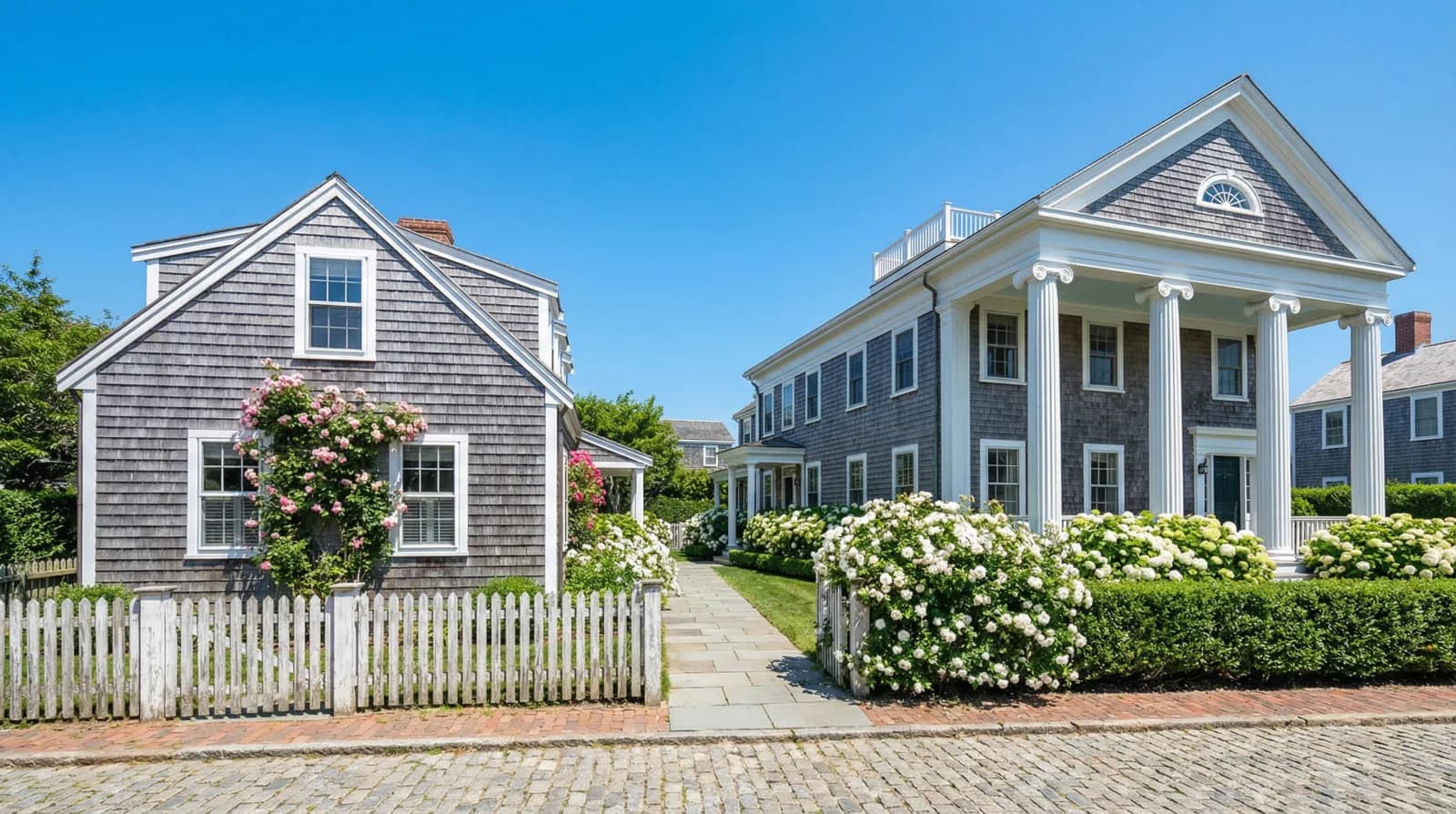
- Bold columned porticos: Full-height columns supporting prominent porches
- Triangular pediments: Roof gables treated as classical pediments
- Heavy cornices: Substantial projecting trim at rooflines
- Symmetrical window placement: Formal arrangements following classical rules
- White or light-colored paint: A departure from Nantucket's gray shingle tradition
Notable Examples
The Hadwen Houses on Main Street showcase grand Greek Revival design. Their columned facades represent the ambitions of Nantucket's most successful merchants at the peak of whaling prosperity.
The Atheneum, rebuilt after the Great Fire of 1846, demonstrates Greek Revival applied to civic architecture.
Where to Find Greek Revival
Greek Revival homes are less common than Federal style but appear in prime locations:
- Upper Main Street
- Select examples on Orange Street
- The downtown district core
Real Estate Considerations
Greek Revival homes are relatively rare on Nantucket, making them particularly collectible. Their grand scale and formal character appeal to buyers seeking statement properties.
Price Range: $5M-$18M
Considerations: The painted exteriors typical of Greek Revival require more maintenance than weathered shingles. Large-scale interior spaces may require significant heating and cooling investment.
Shingle Style (1880s-1910s)
The Shingle Style represents a distinctly American architectural achievement, and Nantucket became one of its most important expressions. Architectural historian Vincent Scully famously called this approach "the architecture of the American summer."
The style emerged as a deliberate rejection of Victorian ornamentation in favor of simpler forms inspired by colonial and early American buildings. Its practitioners looked to structures like Nantucket's earliest homes for inspiration, then reinterpreted those forms for the leisure class of the Gilded Age.
The Philosophy Behind the Style
Shingle Style architects sought to strip away what they called "that vast agglomeration of ornateness" that characterized Victorian design. They embraced America's colonial heritage, creating buildings that felt rooted in the landscape rather than imposed upon it.
The style was a resort form, built primarily for summer use by wealthy families seeking casual luxury. Unlike the formal symmetry of Federal and Greek Revival, Shingle Style embraced irregular massing and flowing interior spaces.
Visual Characteristics
- Wood shingle siding: Shingles wrap the entire structure, creating a unified skin
- Irregular massing: Complex forms with turrets, bays, and projecting wings
- Sweeping rooflines: Gambrel, hip, and gable roofs often combined on a single structure
- Deep porches and verandas: Shaded outdoor living spaces integral to the design
- Large, grouped windows: Window bands and picture windows capture views
- Integration with landscape: Buildings nestle into their sites rather than dominating them
- Minimal applied ornamentation: The texture of shingles provides visual interest
Where to Find Shingle Style Estates
Shingle Style properties cluster in Nantucket's most prestigious locations:
- Cliff Road and the Cliff neighborhood feature grand examples with harbor views
- Monomoy area showcases substantial summer estates
- Brant Point includes Victorian-era Shingle Style cottages
- Select waterfront locations around the island
- Sconset contains more modest Shingle Style interpretations
Real Estate Considerations
Shingle Style estates rank among the highest-value properties on the island, prized for their scale, craftsmanship, and settings.
Price Range: $8M-$45M+
Considerations: These properties require substantial maintenance and operating costs. Original shingle work may need restoration. Complex roof systems require experienced contractors. Many include multiple structures and significant grounds requiring management.
Modern Interpretations
Contemporary construction on Nantucket must navigate between modern building requirements and historic preservation standards. The best examples reference traditional forms while providing current amenities.
What HDC Allows
The Historic District Commission requires new construction to complement the island's character. Successful modern homes typically feature:
- Shingle or clapboard siding in approved colors
- Roof pitches and forms that reference historic precedents
- Window proportions compatible with traditional styles
- Massing that fits neighborhood context
- Screened mechanical equipment
Contemporary Design Within Tradition
The most successful recent construction demonstrates that excellent modern architecture can coexist with historic preservation. These homes provide open floor plans, modern systems, and contemporary amenities while presenting exteriors that honor Nantucket tradition.
Price Range: $3M-$25M+ for new construction
Considerations: New construction faces strict HDC review. Sites may have limitations on size and placement. The permitting process typically takes longer than in non-historic areas.
Architectural Elements Across Styles
Certain features appear throughout Nantucket's architectural history, creating visual continuity across periods.
The Widow's Walk
Rooftop platforms, traditionally explained as vantage points for watching for returning ships, appear on Federal and Greek Revival homes. Whether this origin story is accurate or apocryphal, widow's walks remain a distinctive Nantucket feature.
The Weather-Gray Shingle
Cedar shingles exposed to salt air weather to a distinctive silver-gray. This characteristic appearance defines Nantucket's aesthetic and is essentially required for historic properties under HDC guidelines.
The White Picket Fence
Low white picket fencing defines property boundaries throughout historic neighborhoods, creating the streetscape character that visitors and residents cherish.
The Rose-Covered Trellis
Particularly in Sconset, climbing roses on cottages and trellises became a defining feature. This tradition began when artists discovered the village in the late 1800s.
Choosing the Right Style for You
Different architectural styles suit different buyers and purposes.
For Historic Purists
Lean-to homes, Federal captain's houses, and original Sconset cottages offer the deepest connection to Nantucket's past. These properties require commitment to preservation but reward owners with irreplaceable authenticity.
For Summer Entertaining
Shingle Style estates provide the grand scale, multiple bedrooms, and outdoor living spaces ideal for hosting family and guests. Their design specifically anticipated summer use.
For Year-Round Living
Federal homes and Cape Cod cottages in the downtown core offer walkability to year-round services while providing manageable scale for permanent residence.
For Investment Focus
All historic styles hold value due to scarcity, but well-preserved Federal and Shingle Style homes have demonstrated the strongest appreciation over time.
Working with Historic Styles
Owning a historic Nantucket property means becoming a steward of architectural heritage. The rewards include living in irreplaceable spaces that connect you to centuries of American history.
Key principles for success:
- Engage specialists: Work with architects and contractors experienced in Nantucket historic renovation
- Understand HDC process: Factor approval timelines into any renovation planning
- Preserve original fabric: Repair rather than replace whenever possible
- Respect the style: Additions and alterations should complement, not compete with, original design
- Budget appropriately: Historic renovation typically costs more than standard construction
Next Steps
Whether you seek a romantic Sconset cottage, a commanding Federal captain's house, or a grand Shingle Style estate, understanding Nantucket's architectural traditions helps you find the right property.
- Browse Current Listings
- Schedule a Consultation
- Explore Downtown Nantucket
- Discover Sconset
- Read the Complete Historic Homes Guide
Let me help you find your place in Nantucket's remarkable architectural story.
Work with a Nantucket Expert
Looking for your Nantucket home? John Trudel has been helping buyers find their perfect island property for over 29 years. With deep local knowledge of every neighborhood, pricing trend, and historic consideration, he provides the guidance you need to make a confident decision.
Schedule a consultation to discuss your goals, or browse current listings to start exploring.