Explore Nantucket's grand whaling captain homes and historic mansions. From the Three Bricks to the Hadwen House, discover the architectural legacy of the island's maritime prosperity and what it takes to own these remarkable properties today.
Nantucket's grandest homes tell the story of a remarkable era when the island commanded the world's whale oil trade. The mansions lining Main Street, Orange Street, and surrounding lanes were built by captains who sailed the world's oceans and merchants who turned their voyages into vast fortunes. Today, these properties represent the pinnacle of Nantucket real estate, combining irreplaceable historic significance with enduring architectural beauty.
For a comprehensive overview of historic preservation on the island, see our Complete Nantucket Historic District Guide.
The Whaling Wealth That Built an Island
From the 1690s until the 1850s, the pursuit of whales was Nantucket's primary business. By the mid-1700s, the island had become the whaling capital of the world. This maritime enterprise generated extraordinary wealth, and successful captains and oil merchants invested their fortunes in substantial homes that reflected their prosperity while honoring the restraint valued by the island's Quaker heritage.
The hierarchy of the whaling industry created distinct classes of homeowners. Ship captains who successfully commanded multiple voyages accumulated enough wealth to build grand residences. Whale oil merchants who financed expeditions and traded the precious cargo often achieved even greater fortunes. Together, these maritime aristocrats created the architectural legacy that defines Nantucket today.
The wealth was remarkable by any era's standards. A single successful whaling voyage could yield profits equivalent to millions in today's currency. Captains might spend three to four years at sea, sailing as far as the Pacific, before returning with holds full of sperm oil and whale bone. The most successful captains made multiple voyages, compounding their wealth with each expedition.
The Three Bricks: Main Street's Crown Jewels
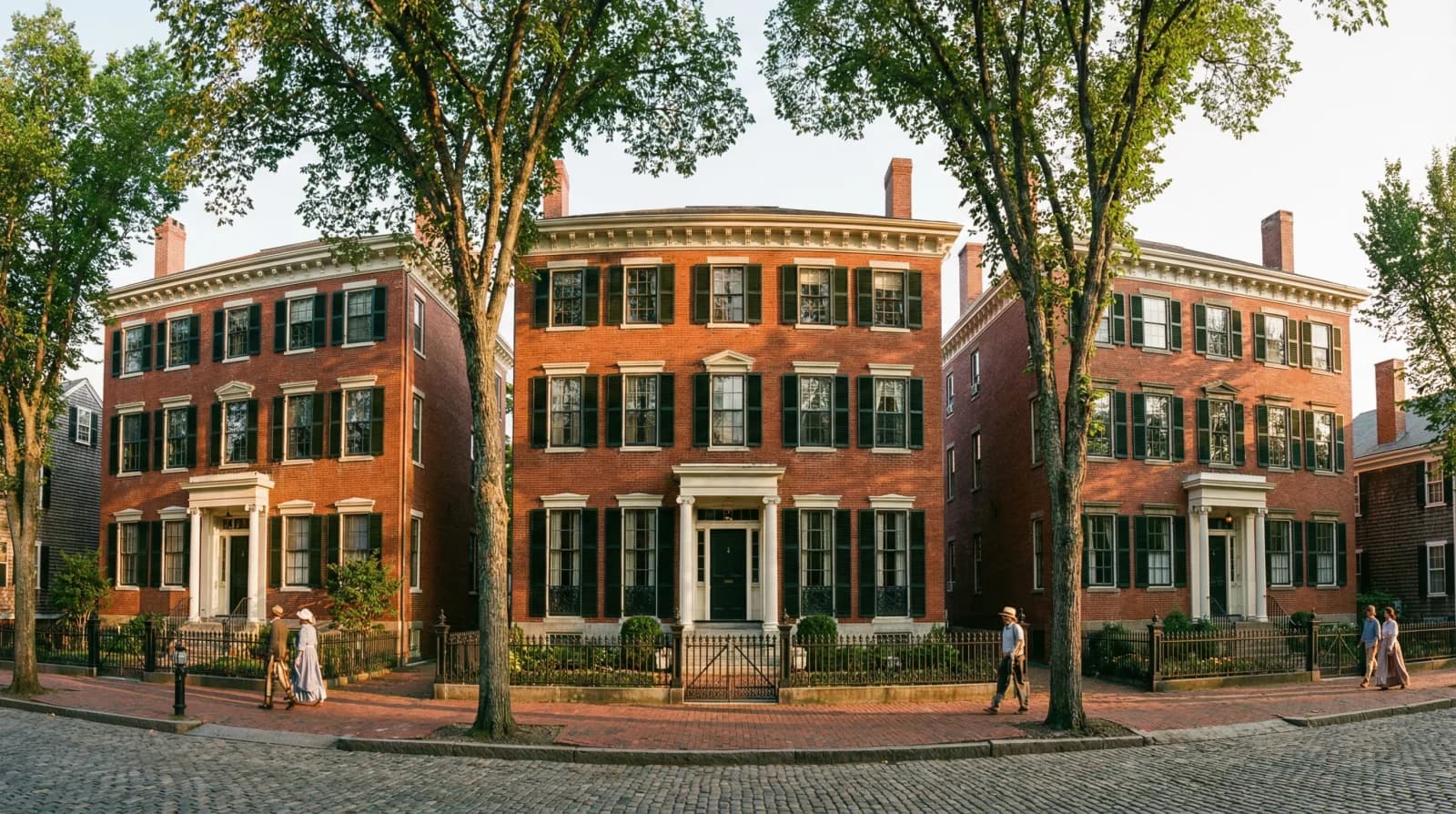
No discussion of Nantucket's whaling-era mansions can begin anywhere but the Three Bricks at 93, 95, and 97 Main Street. These matching Federal-style brick residences stand as the island's most iconic architectural statement, built between 1836 and 1838 by whale oil merchant Joseph Starbuck for his three sons: George, Matthew, and William.
The Three Bricks represent the height of Nantucket prosperity and parental ambition. Joseph Starbuck, who made his fortune as a whale oil magnate, commissioned these homes to ensure each of his sons would have an equally grand residence. The matching facades speak to both the family's wealth and the Quaker emphasis on equality and harmony.
Architectural Features:
- Matching Federal-style brick construction
- Symmetrical facades with centered entries
- Delicate white trim and classical proportions
- Period-appropriate interior details and craftsmanship
- Rooftop widow's walks offering harbor views
The Three Bricks rarely, if ever, come to market. When they do, they command prices reflecting their status as irreplaceable American architectural treasures. Ownership of one of these properties means possessing not merely a home but a piece of American maritime history recognized worldwide.
Hadwen House: Greek Revival Grandeur
Directly across Main Street from the Three Bricks stands Hadwen House, representing a slightly later architectural statement. Built in 1845 for William Hadwen, a prominent silver trader and whale oil magnate, this Greek Revival mansion showcases the bold columned design popular in America during the 1840s.
Now operated as a museum by the Nantucket Historical Association, Hadwen House demonstrates the transition in architectural taste that occurred just as the whaling industry reached its peak. Where the Three Bricks reflect Federal restraint, Hadwen House embraces the more dramatic Greek Revival vocabulary with its imposing columned portico.
Notable Features:
- Grand columned entrance in Greek Revival style
- Period furnishings and decorative arts on display
- Gardens reflecting 19th-century landscape design
- Original interior architectural details preserved
The property illustrates how Nantucket's wealthiest residents expressed their status through architecture while remaining within the bounds of community expectations. Even at its most grand, Nantucket architecture retained a sense of proportion and craft that distinguished it from the more ostentatious displays on the mainland.
The Levi Starbuck House: Orange Street Elegance
The Levi Starbuck House at 14 Orange Street, built in 1837, represents another pinnacle of whaling-era residential architecture. Levi Starbuck, a whale oil merchant connected to one of Nantucket's most prominent families, commissioned this substantial home during the same period that saw the construction of the Three Bricks.
The Starbuck name appears throughout Nantucket's whaling history. The family produced captains, merchants, and community leaders across multiple generations. Their homes, scattered throughout downtown Nantucket, trace the family's prosperity from modest early structures to the grand residences of the 1830s and 1840s.
The Levi Starbuck House exemplifies the Federal style adapted for Nantucket's unique context. Its proportions, materials, and details reflect the sophisticated architectural sensibility that characterized the island's most significant residences. The home has been recognized by the Nantucket Preservation Trust as an iconic example of grand Nantucket architecture.
Captain Robert Calder House: Cliff Road Heritage
At 10 Cliff Road, the Captain Robert Calder House built in the 1820s represents a different expression of whaling-era prosperity. Cliff Road developed as a prestigious residential address where successful maritime families built homes overlooking the harbor. Captain Calder's residence reflects the Federal style that dominated Nantucket construction during the early 19th century.
The Cliff Road corridor became home to many of the island's most substantial properties. Its elevated position offered views of the harbor below while providing slightly more distance from the bustling commercial waterfront. Today, properties in this area remain among Nantucket's most valuable, commanding prices that reflect both historic significance and exceptional settings.
Captain George Pollard House: A Survivor's Home
The Captain George Pollard House on Centre Street carries a particularly dramatic history. Captain Pollard commanded the whaleship Essex, which was famously attacked and sunk by a sperm whale in 1820, an incident that later inspired Herman Melville's Moby-Dick.
The house itself, constructed in 1760 by Captain William Brock, predates Pollard's ownership but is forever associated with the Essex tragedy and its storied commander. The classic saltbox structure with brick-red wooden shingles represents an earlier era of Nantucket architecture than the grand Federal and Greek Revival mansions, yet carries historical significance beyond its architectural merit.
Pollard survived the Essex disaster and its harrowing aftermath, eventually returning to Nantucket where he lived out his days as a night watchman, a far more modest occupation than his former command. The house stands as a reminder that the whaling life brought both fortune and tragedy to those who pursued it.
Architectural Characteristics of Whaling Captain Homes
The grand homes built by Nantucket's maritime aristocracy share certain defining characteristics that distinguish them from lesser structures while maintaining the island's unified aesthetic.
Federal Style Elements
Most whaling captain homes built between 1790 and 1845 embrace the Federal style, characterized by:
- Symmetrical facades with centered entrance doors
- Fanlights and sidelights framing front doorways
- Delicate exterior trim and refined moldings
- Multi-paned windows with thin muntins
- Hip or gable roofs often featuring widow's walks
- Brick or quality shingle construction depending on the period
The Federal style suited Nantucket's Quaker sensibilities. It conveyed prosperity and refinement without excessive ornamentation or display. Even the grandest Federal homes maintained a sense of restraint that contrasted with more elaborate mainland expressions of the style.
Interior Craftsmanship
Inside these homes, quality craftsmanship extended through every detail:
- Wide hallways with handsome staircases set at easy angles
- Paneled doors with original hardware
- Plaster walls with chair rails and crown moldings
- Original flooring, often hand-planed wide boards
- Period fireplaces with fine mantels
- Built-in cabinetry and storage
These interiors were designed for both beauty and function. The wide halls and generous proportions accommodated the social obligations of wealthy families while providing comfortable daily living. Many homes featured winder staircases, a distinctly Nantucket feature that has served island houses for centuries.
Widow's Walks
The rooftop platforms known as widow's walks became synonymous with Nantucket captain's houses. Despite the romantic name suggesting wives watching for returning ships, these features served more practical purposes. They provided access for chimney maintenance and fire spotting while offering views across the harbor and surrounding landscape.
For today's buyers, a functioning widow's walk represents both historic authenticity and a unique amenity, offering panoramic views unavailable from ground level.
Current Market Status
Whaling captain homes and merchant mansions occupy the apex of Nantucket's real estate market. These properties combine irreplaceable historic significance with prime downtown locations, creating a category of real estate that transcends typical market analysis.
Price Expectations
- Significant captain's houses: $8M-$25M+
- Merchant mansions on Main Street: $10M-$30M+
- Federal homes on Orange Street: $6M-$18M
- Cliff Road historic estates: $12M-$40M+
These ranges represent starting points for serious discussion rather than firm boundaries. Truly exceptional properties with documented provenance and pristine preservation may command prices well above these figures.
Market Characteristics
The market for premier whaling-era homes operates differently from standard real estate transactions:
Extreme Scarcity: No new whaling captain homes can ever be created. The supply is permanently fixed, and most remain in families who acquired them generations ago.
Off-Market Transactions: Many significant historic properties trade privately, never appearing in public listings. Relationships and reputation matter more than marketing in this rarified segment.
Multi-Generational Ownership: Properties may remain in the same family for 50, 100, or even 150 years. When transitions occur, they often happen within extended family networks or among established island connections.
Patient Acquisition: Buyers seeking these properties may wait years for appropriate opportunities. Success requires both preparation and persistence.
For insights into the broader Nantucket market context, see our Downtown Nantucket Real Estate Guide.
What It Takes to Own a Whaling Captain Home
Acquiring and maintaining one of Nantucket's grand historic homes requires commitment beyond the substantial purchase price.
Financial Considerations
Acquisition Costs: Beyond the purchase price, expect significant transaction costs including specialized inspections, legal review of any preservation easements, and insurance preparation.
Maintenance Requirements: Historic homes require ongoing preservation-appropriate maintenance. Sea air, salt exposure, and Nantucket's damp conditions demand constant attention. Budget for specialized craftspeople who understand historic materials and methods.
Renovation Complexity: Any exterior work requires Historic District Commission approval. Projects take longer and cost more than comparable mainland work. Build adequate timeline and budget contingency into planning.
Operating Costs: Large historic homes carry substantial utility, insurance, and property tax expenses. Heating 19th-century construction through Nantucket winters requires significant energy expenditure.
Preservation Responsibilities
Owning a significant historic home means accepting stewardship responsibilities:
Maintain Historic Character: The elements that make these homes significant must be preserved. Original windows, hardware, moldings, and architectural details require careful maintenance rather than replacement.
Appropriate Repairs: When repairs become necessary, use historically appropriate materials and methods. Portland cement on historic masonry, over-sanding of wood floors, or replacement of original features with modern alternatives diminishes both authenticity and value.
Sensitive Updates: Modern systems can be integrated but must be screened from view. The Historic District Commission provides guidance on appropriate approaches to HVAC, solar, and technology installations.
Professional Team Requirements
Successfully owning a whaling captain home requires the right professionals:
- Architect experienced in historic preservation and HDC navigation
- Contractors with documented expertise in period construction methods
- Attorney familiar with preservation easements and historic property matters
- Insurance specialist who understands coverage needs for irreplaceable structures
Learn more about Nantucket's historic architectural styles that define these properties.
The Living Legacy
Nantucket's whaling captain homes are more than architectural artifacts. They remain functioning residences, many occupied by families who treasure their historic character while adapting them for contemporary life.
Walking Main Street today, you encounter an unbroken streetscape that Captain Pollard or merchant Starbuck would recognize. The Three Bricks still anchor the upper block, the Hadwen House still commands its prominent position, and the surrounding streets still feature the homes of the families who built Nantucket's maritime empire.
This continuity represents one of the most remarkable achievements of historic preservation anywhere in America. Economic decline after the whaling era's collapse meant Nantucket lacked resources for new construction, inadvertently preserving what might otherwise have been demolished. When prosperity returned through tourism, residents recognized the value of what had survived.
Today's owners of whaling captain homes continue that preservation tradition. They accept the responsibilities that come with owning irreplaceable American heritage, maintaining these structures for future generations while enjoying the incomparable experience of living within them.
Exploring Nantucket's Historic Mansions
Whether you're interested in purchasing a whaling-era mansion or simply appreciating these architectural treasures, several approaches can deepen your understanding:
Walking Tours: Organized tours of downtown Nantucket's historic architecture provide context and access to stories that bring these buildings to life.
Museum Properties: The Nantucket Historical Association operates several historic properties as museums, including Hadwen House. Visiting these sites offers insights into period life and architectural detail.
Research Resources: The NHA Research Library maintains extensive archives documenting Nantucket's whaling era, including materials related to specific properties and families.
Finding Your Place in Nantucket's History
Owning a whaling captain home means becoming part of Nantucket's continuing story. These properties connect owners to centuries of maritime heritage while offering residential experiences available nowhere else.
The opportunity to acquire such a property comes rarely. When it does, preparation and expertise make the difference between success and missed opportunity.
- Browse Current Listings
- Schedule a Consultation
- Explore Downtown Nantucket
- Contact Us with Questions
For those with the resources and commitment to own Nantucket's finest historic properties, few experiences can match the privilege of stewardship. These homes have endured for nearly two centuries, and with proper care, they will stand for centuries more.
Work with a Nantucket Expert
Looking for your Nantucket home? John Trudel has been helping buyers find their perfect island property for over 29 years. With deep local knowledge of every neighborhood, pricing trend, and historic consideration, he provides the guidance you need to make a confident decision.
Schedule a consultation to discuss your goals, or browse current listings to start exploring.